


Skip to content

We diagnose and repair failed flashing on Houston commercial roofs - parapets, curbs, penetrations, and edges where most low-slope leaks actually start.

Schedule a Roof Review

  • Why most commercial roof leaks start at the flashing
  • When a low-slope commercial roof in Houston leaks, the field of the membrane is usually fine. The water is almost always getting in at a transition - where the flat roof meets a parapet wall, where it wraps a rooftop unit curb, where a pipe or conduit punctures the deck, or where the membrane turns up at the roof edge. Flashing is the material that seals all of those transitions, and flashing failure is the single most common source of leaks we chase across Greater Houston, from warehouse roofs off the 610 Loop to office and medical buildings near the Galleria and the Texas Medical Center. The field membrane is a broad, simple surface; the flashings are the dozens of complicated, three-dimensional details around everything that interrupts it, and details are where roofs fail.
  • Flashing repair is its own discipline because diagnosing it is harder than diagnosing a field puncture. A failed flashing can let water in at one point and deliver it to a stain on the ceiling thirty feet away, which sends untrained crews patching the wrong spot while the real defect keeps leaking.
  • Where flashing fails on Houston roofs
  • Every flashing on a roof is a place where a watertight surface had to be interrupted and then re-sealed, and each type fails in its own way.
  • Parapet and wall flashing. Where the roof turns up a wall, the membrane is terminated and counterflashed. Houston's heat-driven thermal movement works that termination loose over years, sealant at the top edge dries and cracks under relentless UV, and wind-driven rain off a Gulf storm gets behind it.
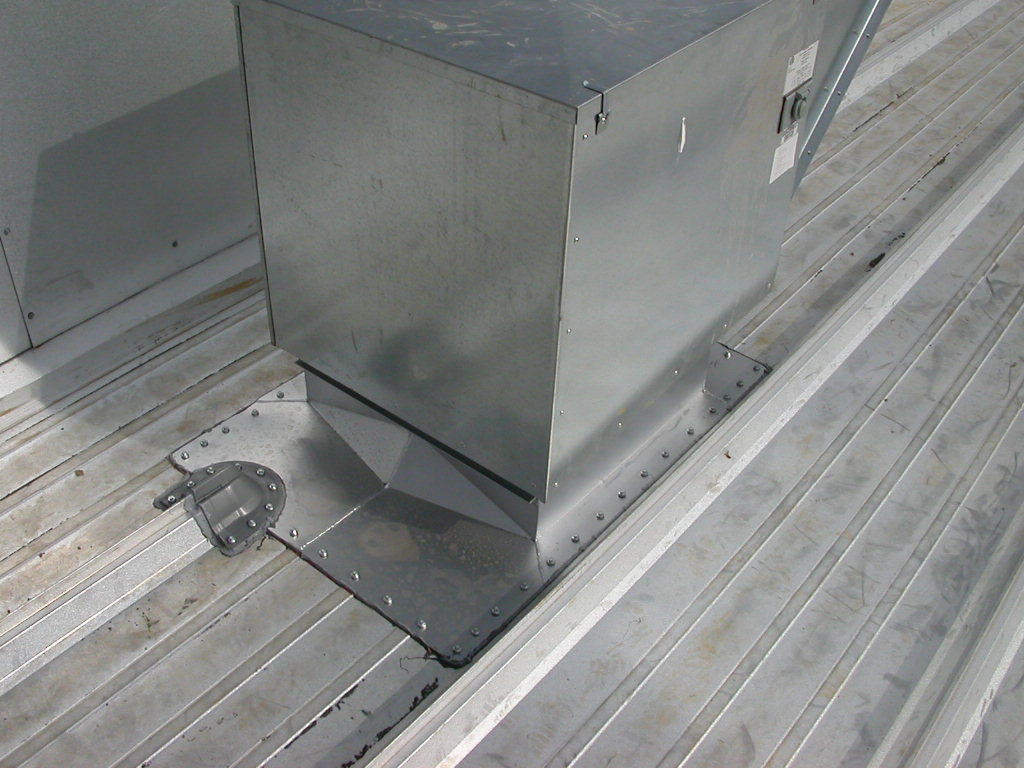
  • Curb flashing at rooftop units. HVAC units, exhaust fans, and skylights sit on curbs, and the membrane has to wrap and seal every one. Service techs walking and working on these units stress the flashing, and the corners of curbs are a classic leak point.
  • Penetration flashing. Pipes, conduit, drains, and supports puncture the roof, each sealed with a boot, pitch pan, or target patch. Pipe boots crack and split in the sun; pitch pans dry out and pull away from what they surround.
  • Edge metal and termination. At the roof perimeter, edge metal and the membrane termination take the full force of hurricane and straight-line wind uplift. When edge details loosen, they admit water and become the starting point for larger wind peel.

Roof planning guidance

Expansion joints. Where a building is designed to move, the joint cover has to flex and stay sealed through years of thermal cycling. What pushes Houston flashings to fail faster The local climate is hard on exactly the parts of the roof that flashing protects. Intense, year-round UV bakes sealants and bituminous flashings brittle. Wide daily temperature swings cycle every detail through expansion and contraction that slowly opens terminations. Hurricane and squall-line wind drives rain horizontally up walls and behind edges, attacking flashings from directions the field membrane never sees. And the sheer volume of rain a Gulf storm can drop means any compromised detail is tested under a real head of water, not a trickle.

Schedule a roof review
Flashing Failure Repair for Houston Commercial Roofs | TX Leak Repair
Downtown Houston commercial rooftops

How we find the flashing that is actually leaking

Chasing flashing leaks is detective work, and guessing is expensive. We start where the evidence points and work back to the true source.

Tracing the leak to its origin

Houston Energy Corridor commercial buildings

Because water travels across and through the roof assembly before it shows up inside, the interior stain rarely sits under the breach. We inspect the flashings uphill and around the area above the leak, look for the failed termination, cracked boot, or open pitch pan that is admitting water, and confirm the path before we commit to a repair. On roofs where water has been getting in for a while, we check whether it has saturated the insulation around the detail, because wet insulation means the repair scope is larger than the visible flashing.

Telling repairable from end-of-life

Not every failed flashing is a simple fix. A single cracked pipe boot on an otherwise sound roof is a targeted repair. But when flashings are failing across the roof at once - terminations lifting, sealants gone everywhere, multiple details opening in the same season - that is often the roof telling you its detailing has reached the end of its service life. We give owners a straight read on which situation they have rather than selling a patch on a roof that needs its flashings rebuilt.

Roof planning notes

Repairing flashing so it holds

Talk with a Houston commercial roofing team

Repairs built for the next storm

A flashing repair has to do two things: stop the current leak and survive the conditions that caused it. We rebuild the detail with materials compatible with the existing roof system - thermoplastic flashing on a TPO or PVC roof, the right accessories on a modified-bitumen or built-up roof - so the repair fuses to the membrane rather than sitting on top of it as a temporary smear of sealant. Parapet and wall. Re-terminate the membrane at the wall, reset or replace counterflashing, and seal the top edge so wind-driven rain cannot get behind it.

Penetrations. Replace cracked boots, rebuild dried-out pitch pans, and re-detail pipe and conduit penetrations with compatible flashing.

Curbs. Re-flash unit and skylight curbs with attention to the corners, the point that fails first under foot traffic and thermal movement. Talk with a Houston commercial roofing team