


Skip to content

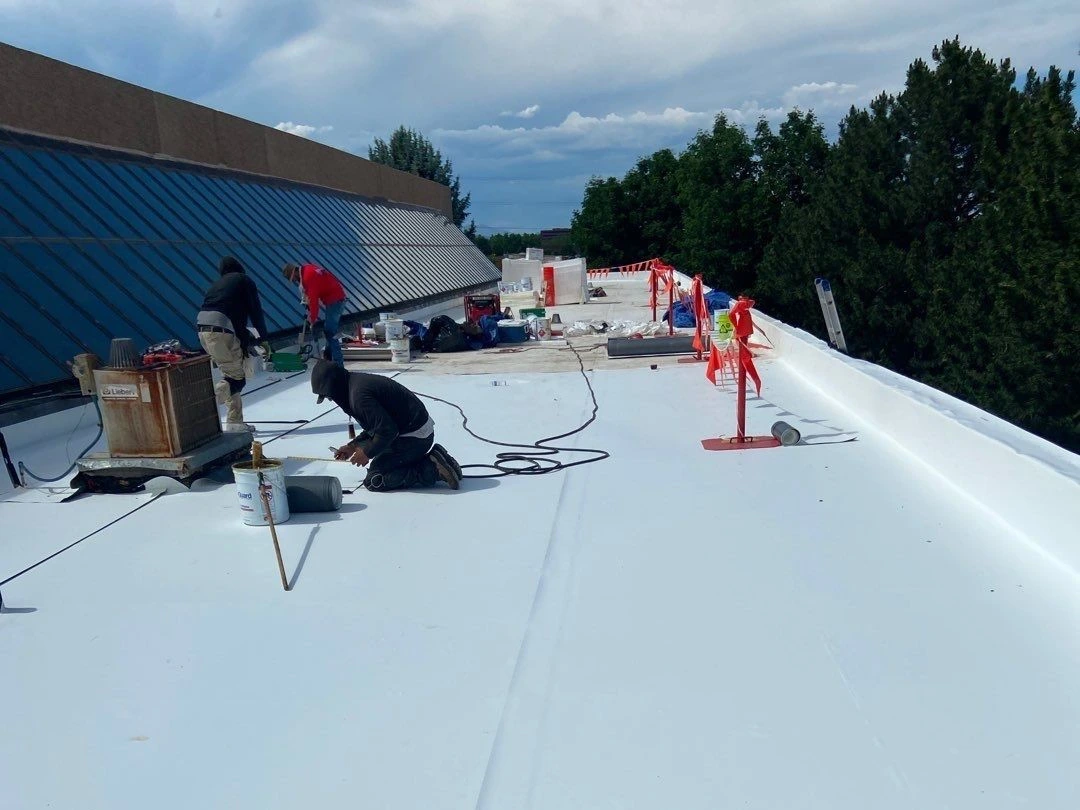
We install 80-mil TPO membrane on Houston commercial and industrial roofs. Thicker reflective white TPO built for Gulf Coast heat, hail, and hurricane wind uplift.

Schedule a Roof Review

  • 80-mil TPO membrane on Houston low-slope roofs
  • We install 80-mil thermoplastic polyolefin (TPO) on commercial and industrial buildings across Greater Houston, from distribution warehouses off Beltway 8 to office and retail stock in Westchase and along the Energy Corridor. The 80-mil designation refers to the total membrane thickness, and the number matters more here than in milder parts of the country. A heavier sheet carries a thicker layer of weathering compound above the reinforcement scrim, which is the portion of the membrane that absorbs UV, foot traffic, and hail before the scrim is ever exposed. On a roof that bakes under Gulf Coast sun nine months of the year and takes the occasional pounding of large hail, that extra weathering reserve is the difference between a membrane that chalks and cracks early and one that holds its surface for the long haul.
  • White TPO also reflects the bulk of incoming solar radiation rather than absorbing it. On a dark or aged roof, the membrane surface can run far hotter than the air temperature on an August afternoon, and that heat drives cooling loads inside the building and accelerates aging of the roof itself. A reflective 80-mil sheet keeps the assembly cooler, which is a practical advantage on a large single-story footprint where the roof is the dominant heat-gain surface.
  • Why 80-mil instead of 45- or 60-mil in this market
  • Most TPO is sold in 45-, 60-, and 80-mil thicknesses. We specify 80-mil when a building owner is making a long-horizon investment and wants the roof to outlast the typical replacement cycle, or when the roof sees conditions that chew through thinner sheets faster.
  • Hail. Harris County sits in a part of Texas that takes damaging hail, and a thicker membrane resists puncture and bruising from impact far better than a 45-mil sheet over the same insulation.
  • Foot traffic. Roofs carrying rooftop HVAC units, condensers, and service crews — common on Galleria-area offices and medical and industrial buildings — wear at walk paths and equipment curbs. The heavier weathering layer tolerates that abuse.
  • UV exposure. Our roofs see intense, year-round ultraviolet load. The thicker the weathering compound over the scrim, the longer the sheet resists surface degradation.
  • Long-term ownership. For owners and property managers holding an asset for decades, the incremental cost of 80-mil over 60-mil is small against the value of a longer service life and fewer mid-life repairs.

What stays the same across thicknesses

The installation method, the hot-air-welded seams, and the chemistry of the sheet are consistent whether we install 60- or 80-mil. What changes is the durability reserve. We walk owners through the tradeoff honestly rather than defaulting to the heaviest sheet on every project — on a short-hold building or a simple roof with little traffic, a 60-mil system can be the right call. How we build an 80-mil TPO assembly

Schedule a roof review
80-mil TPO Roofing Systems for Houston Commercial Buildings
Downtown Houston commercial rooftops

A TPO roof is a system, not just a sheet, and the layers beneath the membrane determine how it performs in Houston rain and wind.

Tear-off, recover, and deck inspection

We start by determining whether the existing roof can be recovered or must come off. Where an old roof holds trapped moisture — common after years of small leaks, or after a major rain event like Harvey in 2017 — recovering over wet insulation only seals the water in. We use moisture survey results to make that call. When we tear off, we inspect the structural deck for corrosion or deterioration before anything new goes down, because a membrane is only as sound as what it is fastened to.

Houston Energy Corridor commercial buildings

Insulation and cover board

We install rigid insulation to the specified R-value, then a cover board over the insulation. The cover board gives the membrane a firm, uniform substrate, improves hail and impact resistance, and adds fire and wind performance to the assembly. Skipping it to save money is a false economy on a roof that has to survive hail and storm wind.

Attachment for Houston wind

Roof planning notes

Roof Scope Notes

Talk with a Houston commercial roofing team

Welded seams and detailing

TPO seams are joined with hot air, fusing adjacent sheets into a continuous, watertight bond. We probe seams after welding to confirm they are fully fused. Penetrations, drains, curbs, and the roof edge are flashed with TPO-compatible accessories so the weak points of the roof are detailed to the same standard as the field. Drainage detailing that respects Houston rainfall

Where 80-mil TPO fits in Houston

Few markets test a flat roof's drainage like ours. Tropical systems and heavy thunderstorms can drop staggering rain totals in hours, and Harris County and the regional flood-control districts manage stormwater across the area. On the roof itself, standing water is the enemy: ponding adds load, accelerates membrane aging, and finds any weak seam. We confirm that drains, scuppers, and overflow provisions can move water off the roof during a real downpour, add tapered insulation to redirect flow toward drains where the deck is dead-flat, and detail every drain and scupper so the most vulnerable points handle the heaviest flow. An 80-mil membrane tolerates incidental ponding better than a thin sheet, but our goal is always to get the water off the roof, not to rely on the membrane to sit underwater. Talk with a Houston commercial roofing team