


Skip to content

TPO Single Ply Roofing in Houston, TX

Schedule a Roof Review

  • TPO single-ply roofing for Houston commercial buildings
  • TPO has become the default flat-roof membrane on commercial buildings across the country, and for good reason: it pairs a bright, heat-reflective surface with heat-welded seams at a price that makes sense over large rooftops. Those are exactly the two things a roof needs on the upper Gulf Coast, where buildings cook under the sun most of the year and the flat, low-slope rooftops that dominate Houston's commercial stock have to shed enormous amounts of water. We install TPO across Greater Houston and Harris County on the buildings it suits best: warehouses and distribution centers along the Ship Channel and the beltway, retail strips and big-box stores off the major freeways, office buildings in Westchase and the Energy Corridor, and the countless mid-size commercial roofs in between.
  • What TPO is and why the welds matter
  • TPO stands for thermoplastic polyolefin, and the word that earns its keep is thermoplastic. A thermoplastic membrane can be melted and re-fused with heat, which means the seams between sheets are welded together with hot air rather than glued with adhesive or taped with a cover strip. When two sheets are hot-air welded correctly, the overlap fuses into a single continuous piece of material. There is no separate adhesive bond line to dry out, peel, or fatigue.
  • On a Houston roof that swings from a cool January morning to a surface temperature well over 150 degrees in August, that distinction is decisive. Adhesive-based laps are the first thing to give up under that kind of repeated expansion and contraction, and a glued seam that has aged through a few Gulf Coast summers is a leak waiting for the next storm. A properly welded TPO seam carries the strength of the membrane itself and does not have that weakness.
  • The reflective surface earns its keep here
  • TPO's standard white, reflective top surface is not a cosmetic choice. Houston runs its air conditioning the better part of the year, and a dark roof can add real load to a building's cooling system every afternoon. A bright TPO membrane bounces a large share of solar radiation back off the roof, which lowers rooftop surface temperatures, eases the strain on HVAC, and slows the thermal aging of the membrane and the insulation beneath it. A reflective TPO roof frequently meets cool-roof criteria and can qualify for energy-related credits, and for a building running cooling loads from spring through fall, the reduction in rooftop heat is a line item you can feel in the operating budget.
  • How we build a TPO roof
  • A durable TPO roof is as much about what goes on under the membrane as the membrane itself. Welding a good sheet over saturated insulation or a failing deck only buries the problem, so we evaluate the existing assembly first and build up from a sound base.

Roof planning guidance

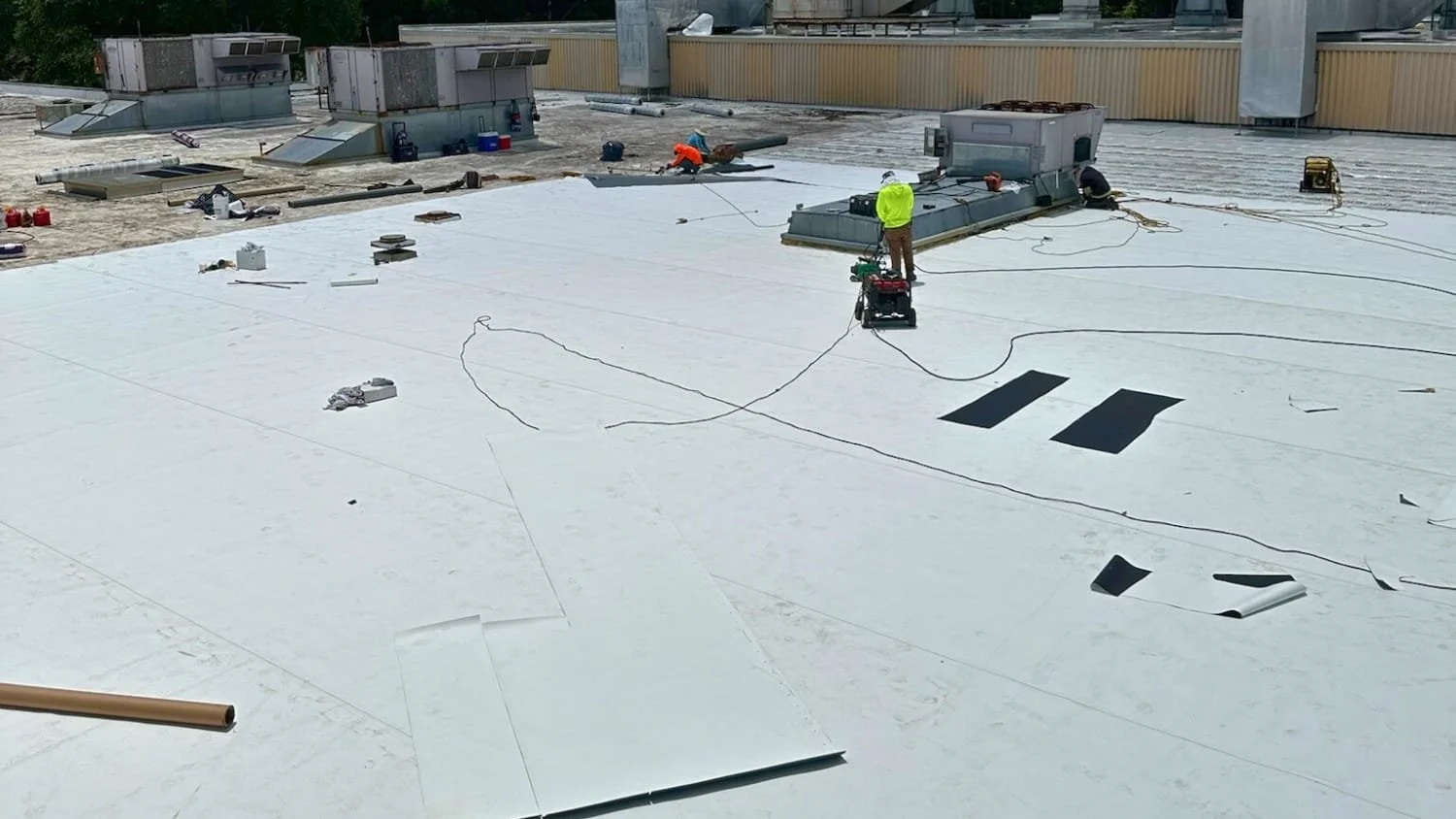
Inspection and, where needed, repair or replacement of the structural deck Installation of the appropriate thickness of polyiso insulation to hit the building's thermal target, topped with a cover board that gives the membrane a firm, puncture-resistant substrate Attachment of the TPO membrane by the mechanically fastened, fully adhered, or, less commonly, ballasted method that fits the building's wind exposure and slope

Schedule a roof review
TPO Single Ply Roofing in Houston, TX
Downtown Houston commercial rooftops

Hot-air welding of every seam, followed by probing each weld to confirm a continuous, watertight bond

Detailing of penetrations, curbs, drains, and parapet flashings with TPO-coated metal and pre-formed corners and boots

We also pay attention to membrane thickness. A heavier TPO carries a thicker layer above the reinforcement scrim, which is the layer that takes the wear from foot traffic, hail, and years of UV. On a roof that will be walked for HVAC service and exposed to Gulf Coast hail, specifying the right thickness up front is far cheaper than re-roofing early.

Houston Energy Corridor commercial buildings

Penetrations are where roofs leak

The flat field of a TPO roof is the straightforward part. Houston commercial roofs are crowded with rooftop equipment, HVAC curbs, exhaust fans, plumbing vents, gas lines, and conduit, and every one of those is a potential leak. Because TPO is weldable, we can fuse the membrane directly to TPO-clad metal and pre-formed accessories at each of these transitions, extending the same monolithic seal across the difficult details that the field of the roof enjoys. A roof is won or lost at its penetrations, and weldable detailing is one of TPO's real advantages there.

Engineering TPO for Gulf Coast storms

Roof planning notes

Roof Scope Notes

Talk with a Houston commercial roofing team

Ponding, drainage, and heavy rain

Between routine Gulf downpours and the flat terrain that gives our roofs very little slope to work with, water sits on Houston's low-slope roofs longer than in most of the country, and the county's drainage requirements exist because this region cannot afford water with nowhere to go. We build TPO assemblies with positive drainage in mind, detail the drains and scuppers to move water off the roof efficiently, and flag areas of ponding that add dead load and shorten membrane life. A welded TPO membrane tolerates incidental standing water far better than an adhesive-seamed system, but no flat roof should be asked to hold water it was meant to shed, and getting the drainage right is part of every install we do. Maintenance keeps a TPO roof on schedule

Talk to us about a TPO roof assessment

Like any commercial roof, TPO rewards routine attention and punishes neglect. We recommend inspections after major storms and at least twice a year, with particular focus on keeping drains and scuppers clear, checking the seams and flashings around any rooftop equipment that has been added or serviced, and catching punctures before they find the insulation. Caught early, a small issue at a penetration is a quick weld; ignored, it becomes wet insulation, interior damage, and a claim. A TPO roof that is inspected and maintained will run its full service life; one that is left alone will not. Talk with a Houston commercial roofing team