Hurricane and Wind Uplift Repair for Houston Commercial Roofs
Every commercial roof along the upper Texas coast lives under the threat of wind. Hurricane season runs June through November, and it doesn't take a direct landfall to peel a membrane: the outer bands of a Gulf storm, or even a strong summer squall line, can generate the uplift pressures that strip a flat roof off its deck. We repair wind-damaged commercial roofs across Greater Houston, from the membrane that started lifting at the corners to the roof that lost half its field overnight. The work has to be done right, because a roof that failed once under wind will fail again unless the underlying weakness is fixed.
Wind uplift is not a surface problem. It's a force that finds the weakest attachment in the assembly and pulls until something gives. Our repairs start by finding where the wind got its grip, then rebuilding that connection so the next storm can't exploit it.
How Wind Uplift Destroys a Flat Roof
Uplift works from the edges in. As wind moves across a building, it accelerates over the roof and creates negative pressure that tries to suck the membrane upward, with the strongest forces concentrated at corners, perimeters, and any raised detail.
Edge and Corner Peeling
The perimeter is where almost every wind failure begins. If the edge metal or termination bar is loose or under-fastened, wind catches the lip, balloons the membrane, and progressively peels it back toward the center of the roof. We've repaired plenty of roofs in the Westchase and Galleria areas where a failed edge detail let a storm unzip the entire field. Securing the perimeter correctly is the heart of any durable repair.
Billowing and Fastener Pull-Through
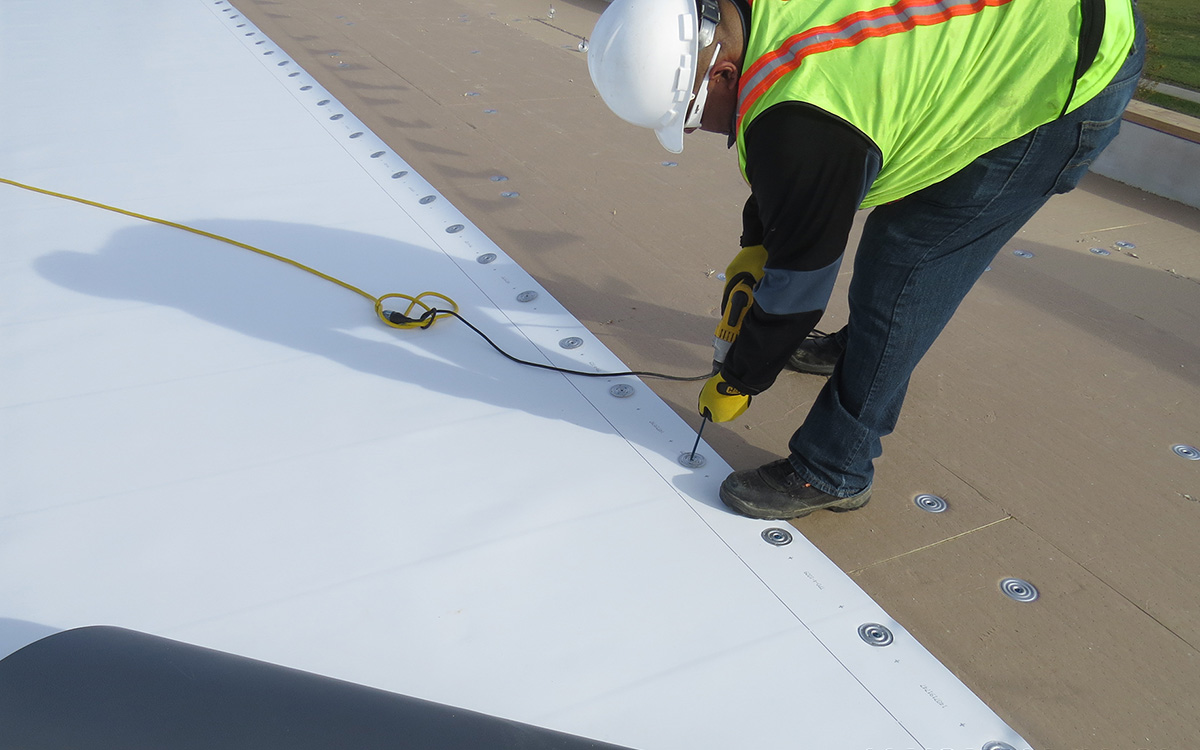
On mechanically attached single-ply roofs, uplift stresses the fasteners and plates holding the membrane down. Under enough suction the membrane billows between rows of fasteners, and the plates can tear through the sheet. Once a few fasteners pull, the load shifts to the rest and the failure cascades. We assess attachment density and pattern, not just the visible tears.
Flashing and Penetration Failures
Curbs, pipes, HVAC units, and parapet flashings all present edges for wind to grab. Driving rain in a Gulf storm then pours through any flashing the wind has loosened. Given how much rooftop mechanical equipment sits on Houston commercial buildings, these details are a frequent point of failure.
Debris Impact
Hurricanes turn gravel, signage, and unsecured rooftop items into projectiles. We find and repair the punctures and gouges that debris leaves behind, which often hide under areas of lifted membrane.
Our Wind Damage Repair Process
Storm response has to be fast but methodical. We move quickly to stop the bleeding, then rebuild properly.
- Emergency dry-in. When a roof is open after a storm, we get out to secure lifted membrane and cover breaches so wind-driven rain stops entering the building. Houston's post-storm rain bands make this urgent.
- Uplift assessment. We trace where the failure started, almost always an edge or attachment point, and evaluate whether the original detailing was adequate for the exposure.
- Perimeter and attachment repair. We re-secure or upgrade edge metal, termination bars, and fastening patterns so the rebuilt area resists higher uplift than what failed.
- Membrane and flashing restoration. We replace torn membrane, reweld or rebuild seams, and reflash penetrations and curbs to a watertight, wind-resistant standard.
- Full-roof check. Wind that damaged one area often loosened others, so we inspect the entire roof for stressed seams and fasteners before calling it done.
Parapets, Equipment Curbs, and the Details That Fail First
The flat commercial roofs across Houston are crowded with details that give wind something to pull on, and these are where we concentrate during a wind repair. A roof field can be perfectly sound while a single failed parapet cap or loose equipment curb becomes the opening that lets a storm in.
Parapet Walls and Coping
Many downtown and midtown buildings have parapets, and the coping or cap metal along the top takes the full force of accelerated wind. When that metal lifts, water gets behind the wall and into the roof-to-wall flashing. We re-secure coping and rebuild wall flashings so the transition between roof and parapet stays sealed under pressure.
Rooftop HVAC and Mechanical Units
Houston buildings carry heavy rooftop HVAC loads to fight the heat, and every unit sits on a curb that interrupts the membrane. Wind works the flashing around these curbs, and the units themselves can shift or shed panels that puncture the roof. We reflash curbs and check that equipment is still properly curbed and sealed after a storm.
Drains, Scuppers, and Overflow Paths
Wind damage and water damage arrive together in a Gulf storm. If uplift has opened the roof while the drainage is overwhelmed by tropical rainfall, water ponds and pours through every breach at once. We make sure drains and scuppers are clear and that the repaired field still sheds water toward them, because a wind repair that ignores drainage just trades one failure for another in Harris County's downpours.
What Our Wind Damage Inspection Covers
A wind inspection has to look past the obvious tear, because the damage that causes the next leak is usually the part nobody noticed. When we assess a storm-hit roof, we work through the whole assembly.
- Perimeter and corners. We check every edge and corner for lifted metal, loosened termination, and membrane that has started to pull, since this is where the next failure will start.
- Fastening integrity. We test attachment across the field to find fasteners that have backed out or plates that have begun to tear through.
- Seams and laps. We probe seams for separation, since wind stresses welds and laps even where the membrane hasn't visibly opened.
- Penetrations and flashings. We inspect every pipe, curb, and wall transition for displacement and water entry.
- Hidden moisture. We look for water that entered during the storm and is now sitting in the insulation, waiting to rot the assembly from underneath.
Building Back Stronger
Repairing wind damage to the exact condition that just failed makes no sense on this coast. Where a roof failed because of weak detailing, we rebuild to current wind standards for the building's height and exposure. That means tighter fastening at the perimeter and corners where uplift peaks, robust edge metal, and properly secured flashings. The goal is a roof that survives the next storm, not just one that's watertight until the next band moves through.
We saw across the region after Harvey in 2017 how the combination of wind and prolonged heavy rain found every weak point in commercial roofs, and how the buildings that came through best were the ones with sound perimeters and well-attached membranes. We build with that lesson in mind.
Repairs Tailored to Your Roof System
Single-Ply TPO and PVC
Mechanically attached and fully adhered single-ply roofs are common on newer Houston commercial buildings. We restore attachment integrity and heat-weld replacement membrane into the field for a continuous, wind-resistant bond.
Modified Bitumen and Built-Up
On older industrial and retail roofs, wind lifts and tears multi-ply asphalt sheets at the laps and edges. We rebuild the affected plies and re-secure the perimeter so the system regains its hold.
Metal Low-Slope Roofs
Standing-seam and metal roofs lose panels and seam integrity in high wind. We re-secure panels, repair opened seams, and address the fastening that let the wind in.
Get Ahead of Hurricane Season
The best time to address wind vulnerability is before the storm, not after. We inspect commercial roofs across Harris County for the loose edges, tired fasteners, and weak flashings that wind exploits, and we shore them up while the weather is calm. If your roof already took wind damage, we'll respond quickly, stop the water, and rebuild the failure point so it holds.
Whether you're preparing a property for the season or recovering from the last storm, contact us and we'll get on the roof, find where the wind has the advantage, and take it away.