Roofing for standalone restaurants across Houston
A freestanding restaurant has a roof problem that strip-center tenants and big-box stores do not: a hot, greasy kitchen exhaust system venting straight up through a relatively small roof, directly over rooms full of paying guests and expensive equipment. Whether it is a pad-site building near the Galleria, a converted bank along Westheimer, or a new-build out in Katy or Cypress, we roof these buildings around the grease, the rooftop equipment, and the simple fact that you cannot close the dining room for a week.
The roofs are small, but they are crowded and they leak in predictable places. We focus on those places.
The grease problem nobody specs for
Kitchen exhaust fans pull airborne grease out of the building and deposit a film on the roof around the exhaust curb. Over time that grease degrades many common single-ply membranes, softening them and breaking down seams right where you least want a leak, over the kitchen and prep line. A roof that would last twenty years on an office building can fail early on a restaurant purely from grease exposure if it was never specified for it. We address it directly:
- Grease-resistant membranes or coatings in the exhaust zone, rather than a standard commercial spec that the grease will eat.
- Grease containment at the exhaust fans so runoff is captured instead of spreading across the field of the roof and into drains.
- Reinforced flashing at the exhaust curbs, the single most common leak point on a restaurant roof.
If your current roof is already grease-soaked and the seams are opening up, we will tell you honestly whether a coating buys you real time or whether you are better served replacing the affected sections.
A small roof carrying a lot of equipment
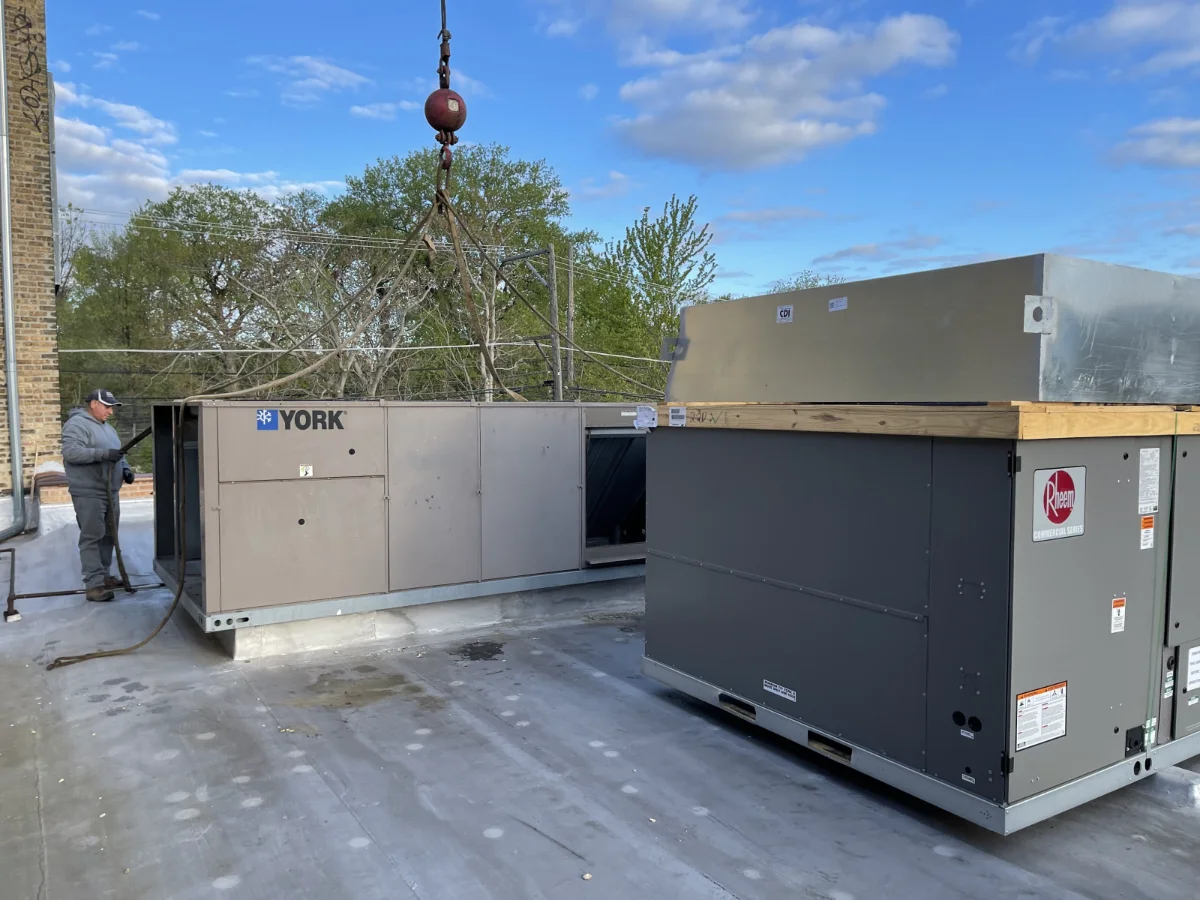
Restaurant roofs are packed: make-up air units, exhaust fans, condensers, refrigeration lines, and gas piping all crowd a few thousand square feet. Every curb and penetration is a potential leak, and Houston's heat and heavy rain find the weak ones fast. We flash and seal each one as its own detail:
- Properly built curbs under RTUs and make-up air units, not field-patched pitch pockets.
- Sealed, supported penetrations for refrigeration and gas lines.
- Walkway pads routing HVAC and hood-cleaning crews so foot traffic does not puncture the membrane around the equipment.
The hood-cleaning vendors, HVAC techs, and refrigeration crews who visit a restaurant roof regularly cause a surprising amount of damage. Defined walk paths and a tougher surface in high-traffic zones pay for themselves.
Drainage that keeps up with Houston rain
A small roof still has to move the same intense Gulf Coast rainfall as a big one, and on a cluttered restaurant roof, equipment and curbs create dead spots where water sits. Ponding water near a grease-softened seam is how a slow leak becomes a ceiling stain over table twelve. We correct it with tapered insulation to push water toward drains, added drains or scuppers where the layout traps it, and overflow protection so a single clogged drain during a downpour does not back water up over the dining room.
Reroofing without closing the dining room
Lost service days are the real cost of a restaurant roof project, often more than the roof itself. We schedule the work to protect your revenue:
- Phasing over the kitchen and dining areas separately so the building stays watertight and usable.
- Early-morning or overnight work where the surrounding area and noise rules allow, so we are off the roof before lunch service.
- Tight daily dry-in, critical on the Gulf Coast, where an afternoon thunderstorm can arrive with little warning.
- Clean, contained tear-off so debris stays out of the parking lot, the patio, and the customer entrance.
Leak repairs over a live operation
Most of what restaurants actually call us for is a leak, water spotting a dining room ceiling, dripping near the line, or showing up in a walk-in's ceiling. We trace these to the source rather than chasing the stain, which on a restaurant roof usually means the exhaust curb, an HVAC penetration, or a seam that grease has opened. We make a durable repair and tell you whether the rest of the roof is close behind, so you can plan instead of getting surprised mid-service.
New-build and conversion roofs across the Houston suburbs
A lot of restaurant roofing in this market is not replacement at all, it is getting a new location right from the start. Pad sites are going up across Katy, Cypress, Sugar Land, and the north suburbs, and just as many operators are taking over a former bank, drugstore, or fast-food building and reworking it for a different kitchen. Either way, the roof has to be set up for how the building will actually run. When we are involved early, we coordinate the exhaust-fan and make-up-air locations with the roof layout so the grease-exposed zone is planned for instead of discovered later, set curbs and penetrations correctly the first time, and lay out drainage around the equipment before it is bolted down. On a conversion, the previous tenant's exhaust and HVAC penetrations rarely line up with the new kitchen, so we patch what is abandoned properly and detail the new openings rather than leaving a roof full of old field repairs.
Patios, awnings, and the parts of the roof customers see
Standalone restaurants put a lot of attention into the parts of the building guests look at, and those areas connect to the roof in ways that leak if they are ignored. Covered patios, drive-thru canopies, tower elements, and decorative parapets all create transitions, low walls, and flashing details where water collects and finds its way in. On a Houston restaurant, a parapet that does not drain or a patio cover tied poorly into the main roof shows up fast during the heavy rains the region gets. We flash these transitions as real details, keep parapet and scupper drainage working, and make sure the visible, customer-facing edges of the building stay watertight and presentable rather than streaked and stained.
Restaurant roof systems we install in Houston
We match the system to the building, the kitchen layout, and how long you plan to hold the location:
- Reflective single-ply membranes for the main field, to cut the cooling load on a small building that runs hot kitchens all day in the Houston heat.
- Grease-rated membranes or coatings in the exhaust zone.
- Roof coatings to extend a sound but aging roof and add reflectivity, where the deck and insulation are still in good shape.
- Modified bitumen on roofs where heavier foot traffic and rooftop service argue for a more robust surface.
From a single repair to a portfolio of locations
We work with independent operators on one building and with restaurant groups and franchisees managing roofs across multiple Houston-area sites, from inside the Loop out to Sugar Land, The Woodlands, and Pearland. For multi-unit owners we can inspect the whole portfolio, flag which roofs need attention first, and standardize the exhaust-zone detail so the same grease problem does not keep recurring location after location. Whether you need a leak stopped before dinner service or a reroof planned around your busiest months, we scope it around keeping your doors open.