60-Mil TPO Roofing for Houston Commercial Buildings
Sixty-mil TPO is the workhorse single-ply membrane on flat and low-slope commercial roofs, and it is the thickness we install most often across Greater Houston. The number refers to the membrane's overall thickness: 60 mils, or sixty-thousandths of an inch. That extra body over a thinner 45-mil sheet gives the roof more puncture resistance for foot traffic and rooftop service work, and more material to weather away before the reinforcing scrim is exposed. For the bulk of the metro's warehouse, retail, office, and light-industrial stock, 60-mil hits the practical balance of durability, longevity, and cost that owners are usually after.
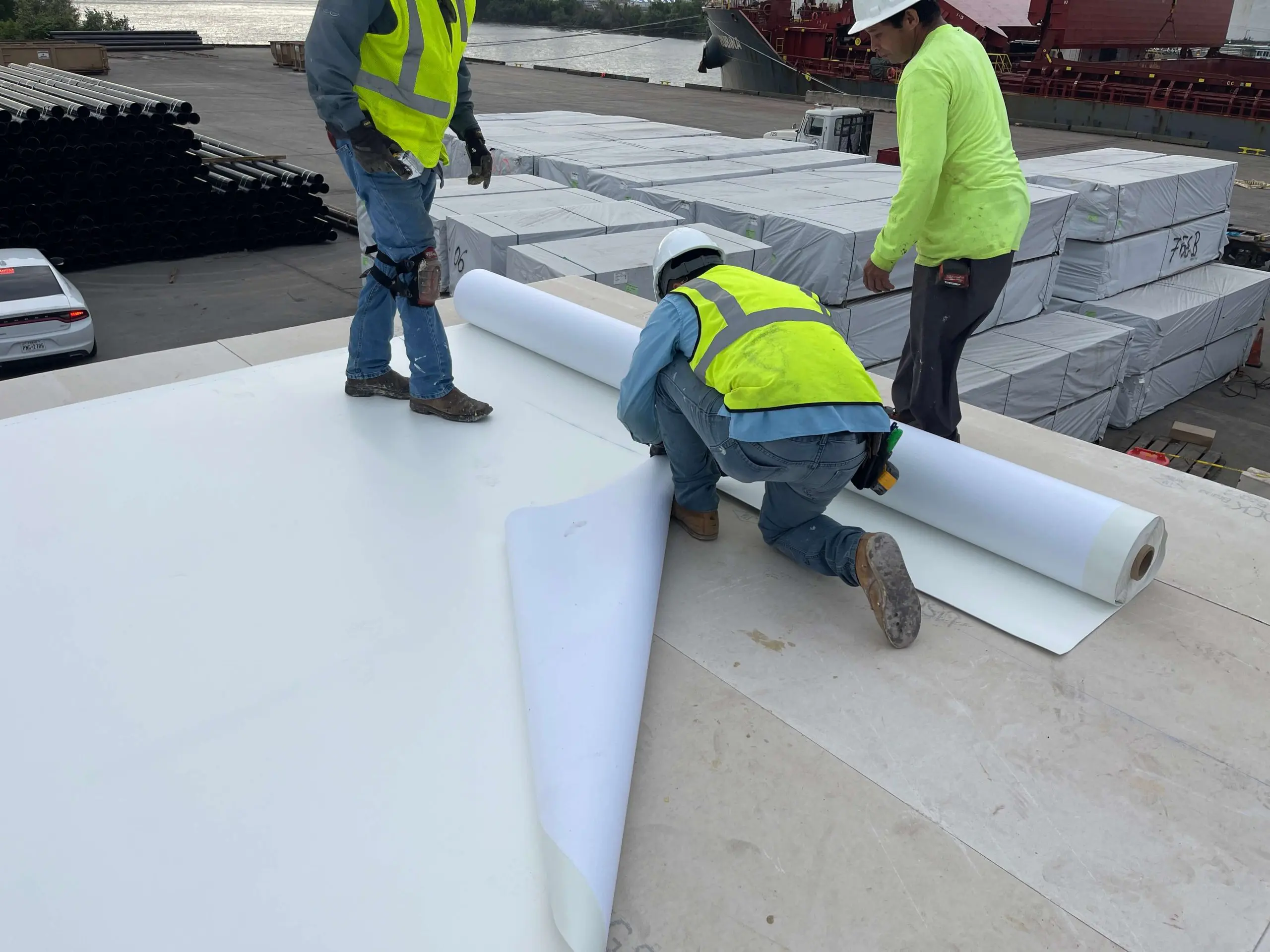
TPO is a thermoplastic membrane installed in wide rolls. The seams where sheets overlap are hot-air welded, fusing the panels into a continuous sheet rather than relying on adhesives or tape. A properly welded TPO seam is as strong as the membrane itself, which removes the failure point that ages adhesive-seamed systems, an advantage that matters under the heavy, wind-driven rain this region gets during storm season.
Why 60-Mil TPO Suits the Houston Climate
A reflective white surface built for the sun
TPO is most often installed in white, and that bright surface reflects the bulk of incoming solar energy instead of absorbing it. Under the relentless Gulf Coast sun, a reflective roof runs far cooler than a dark one on a summer afternoon, which cuts the heat driven into the building and eases the load on rooftop HVAC. For tenants in Energy Corridor and Westchase office buildings, or for refrigerated and conditioned space near the Ship Channel, that reflectivity is a direct line to lower cooling costs through Houston's long hot season.
Welded seams that handle heavy rain
Houston roofs take sudden, intense downpours, and the seams are where single-ply roofs leak first. Heat-welded TPO seams fuse the sheets into one waterproof surface, eliminating the adhesive-dependent joints that loosen over time. On the large flat decks common across Harris County, that seam integrity is what keeps water out when a storm dumps inches of rain in an afternoon.
Resistance to the elements that age roofs here
Modern TPO formulations resist UV breakdown, hold up to tearing and impact, and shrug off the dirt and biological growth that humid Gulf Coast air encourages. The 60-mil thickness gives the membrane a deeper reserve of weathering material, which is part of why it earns longer warranty terms than thinner sheets.
Where 60-Mil TPO Is the Right Call
We specify 60-mil TPO across a wide range of Houston buildings, including:
- Warehouse and distribution roofs along Beltway 8 and the Tollway corridors
- Retail centers and big-box stores
- Office and flex buildings in Westchase, the Galleria area, and the Energy Corridor
- Light-industrial and manufacturing facilities
- Re-roofs where a reflective, mid-weight membrane fits the budget and service goals
For roofs that see heavy foot traffic, frequent rooftop service, or that need maximum longevity, we may recommend stepping up to an 80-mil membrane; for many buildings, though, 60-mil delivers the service life owners want without paying for thickness the roof does not need.
How We Install 60-Mil TPO
Tear-off or recover
Depending on the condition of the existing roof, we either tear off down to the deck or install the TPO over the existing assembly where the structure and code allow. A recover avoids demolition debris and dumpster traffic, but only when the substrate underneath is dry and sound, which we confirm before recommending it.
Insulation and slope
We set rigid insulation boards to the specified R-value, and where a roof ponds we use tapered insulation to build slope toward drains and scuppers. Drainage is a Houston-specific priority: dead-flat decks pond after storms, and engineering positive flow into the assembly keeps water moving off the membrane instead of sitting on it.
Membrane attachment
The TPO is mechanically fastened, fully adhered, or held with a ballast or plate system depending on the building's wind exposure and the deck type. In a region that faces hurricane-season wind, attachment method and fastening pattern are engineered to the wind loads the roof will see, not applied to a generic spec.
Welding and detailing
Seams are hot-air welded and probed to verify a continuous bond. We then detail every penetration, curb, drain, and parapet with TPO-compatible flashings, the rooftop HVAC units, vents, and conduit that crowd most commercial roofs here are where leaks start, so those details get welded and finished with care.
Maintenance and Service Life
A 60-mil TPO roof delivers many years of waterproof, reflective service when it is installed correctly and maintained. We recommend routine inspections, especially after hail or a wind event, to catch punctures, opened seams, or flashing damage early. Houston's large hail can bruise or puncture single-ply membranes, and post-storm inspection is how isolated damage gets repaired before it lets water into the insulation. Welded TPO repairs cleanly: a patch of the same membrane is heat-welded over the damaged area, restoring the continuous surface.
Cost and Value
Part of TPO's dominance on commercial roofs is economics. It delivers a reflective, heat-welded, code-compliant membrane at a lower installed cost than most alternatives, and the 60-mil thickness extends the warranty and service life enough to make the math work for owners managing roofs across multiple buildings. For property managers weighing reflectivity, durability, and budget across a Harris County portfolio, 60-mil TPO is frequently the system that checks every box.
Specifying 60-Mil TPO for Your Roof
Whether you are re-roofing a distribution warehouse, a retail center, or an office building, 60-mil TPO answers the conditions that define roofing in this region: it reflects the heat, welds into a seamless surface that handles heavy rain, and resists the UV and storms that age roofs here, all at a cost that fits most commercial budgets. We evaluate your deck, drainage, wind exposure, and rooftop equipment, then specify the right TPO assembly and attachment for your building rather than a one-size spec.