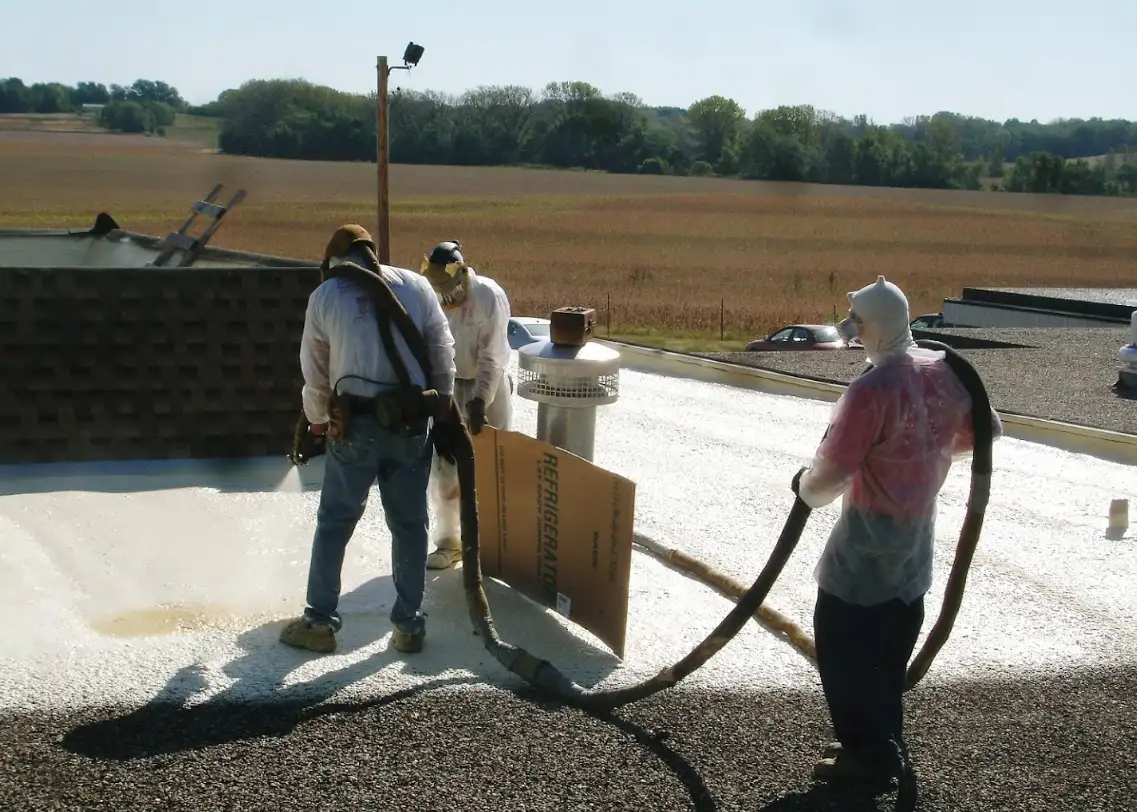
Spray Polyurethane Foam Roofing in Houston
A spray polyurethane foam roof is sprayed on as a liquid that expands into a rigid, closed-cell layer and cures within seconds. It bonds to the substrate below and rises into a single seamless surface across the entire roof, including up and over every curb, pipe, and parapet. There are no laps, no fasteners through the membrane, and no seams for water to find. For the sprawling flat and low-slope buildings that define Houston's commercial stock, from distribution warehouses along Beltway 8 to manufacturing plants near the Ship Channel, that monolithic quality is the whole appeal: water has nowhere to get in.
SPF does two jobs at once. The foam itself is the insulation and the substrate; a protective coating sprayed over it becomes the weatherproof, reflective wearing surface. The combination delivers a roof with the highest insulating value per inch of any commercial system, which matters in a climate where rooftop heat gain drives cooling bills for most of the year.
Why SPF Fits Houston Roofs
It corrects ponding without rebuilding the deck
Dead-flat decks are everywhere in Harris County, and they pond. Because foam is applied as a liquid and built up in passes, we can taper it, adding thickness in low areas to create positive slope toward drains and scuppers. Heavy Gulf Coast rain that used to pool for days after a storm instead runs off. Few other systems let us re-pitch a roof without tearing it off and rebuilding the structure underneath.
It seals around every penetration
A typical Houston commercial roof is crowded with rooftop HVAC units, exhaust fans, conduit, and gas lines, and those penetrations are where most leaks begin. Foam self-flashes; it expands tight around each one and encapsulates it as part of the continuous surface. There are no separate flashing pieces to fail, which removes the most common leak path on built-up and single-ply roofs in this market.
It cuts heat gain and cooling load
The high R-value of closed-cell foam blocks heat from driving into the building through the roof, and the bright reflective topcoat bounces solar energy back off before it is ever absorbed. On a 100-degree Houston afternoon, that keeps the deck cooler and pulls real load off rooftop air conditioning. For temperature-sensitive operations, cold storage, food processing, and lab or medical space near the Texas Medical Center, the thermal performance is often the deciding factor.
It adds structural strength
Once cured, the closed-cell foam is rigid and adds rack strength to the roof assembly, which helps in a region that takes hurricane-season wind. The fully adhered, fastener-free surface gives wind far fewer edges to lift than a mechanically attached membrane.
Where SPF Works Best
We specify foam most often when a building needs insulation upgraded, drainage corrected, or an irregular roofscape sealed cleanly. Strong candidates include:
- Large flat warehouse and distribution roofs that pond after rain
- Industrial and manufacturing buildings with dense, complex rooftop equipment
- Re-roofs where added insulation will pay back in cooling savings
- Roofs over conditioned space where energy performance is a priority
- Existing roofs sound enough to receive foam without a full tear-off
How We Install an SPF Roof
Substrate evaluation and prep
Foam needs a clean, dry, sound surface to bond to. We inspect the existing roof, locate and remove any wet insulation, and confirm the deck is suitable. On many projects SPF can be applied over the existing roof, eliminating tear-off debris and the dumpster traffic that comes with it, but only where the substrate is genuinely dry and stable.
Weather windows matter
Foam will not cure correctly on a damp surface or in the wrong conditions, so application is scheduled around dry windows, a real constraint given how quickly Gulf Coast weather turns. We watch the forecast closely and spray when conditions hold, because a rushed application in marginal weather is a roof that fails early.
Spraying the foam
We apply the polyurethane in lifts to the specified thickness, tapering it across low spots to build slope toward drainage. As it goes down it expands and self-flashes every penetration and rise, forming the single continuous surface that defines the system.
Coating the surface
Cured foam must be protected from UV, so we top it with an elastomeric coating, usually silicone for its ability to shrug off the standing water and intense sun this region throws at a roof. The topcoat provides the reflective white finish, the waterproofing wear layer, and the durability that carries the warranty.
Maintenance and Renewability
An SPF roof is renewable rather than disposable. The foam itself can last for decades; the coating is the wearing layer, and when it weathers down it is cleaned and recoated rather than replaced. That recoat resets the warranty and adds years of life without disturbing the foam or the deck below. Routine inspections, especially after hail or a wind event, catch surface damage early, and isolated dings in the coating are simple to repair because there are no seams or panels to deal with.
Hail and Storm Considerations
Houston takes large hail, and foam roofs can be dented by severe storms. The advantage is that damage is localized and visible on the surface, and the coating-plus-foam buildup can be repaired or recoated in place rather than requiring a section to be cut out and replaced. After any major storm we recommend an inspection so surface impacts are documented and addressed before they let water reach the foam.
Putting SPF to Work on Your Building
For the right roof, spray foam solves several Houston problems in one application: it insulates against the heat, re-slopes a ponding deck, seals a crowded roofscape with no seams, and gives back wind resistance for hurricane season, all of it renewable through recoating instead of replacement. We assess each building's deck, drainage, and rooftop equipment and tell you whether SPF is the strongest option or whether another system fits your structure and budget better.